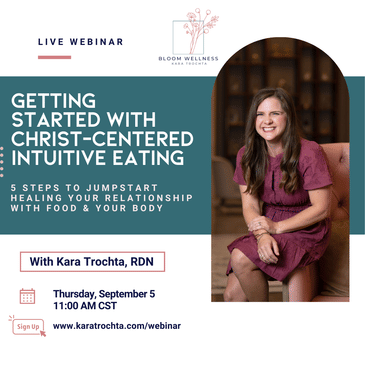
🌟 Exciting News! 🌟 BONUS: Getting Started with Christ Centered Intuitive Eating Webinar Replay
I'm thrilled to share that our latest episode of the "Nourished to Bloom" podcast is now live! This special BONUS episode features a replay of our "Getting Started with Christ Centered Intuitive Eating" webinar. Whether you're new to intuitive eating or looking for a faith-based approach to health and wellness, this episode is packed with valuable insights to help you on your journey.
🔑 Key Takeaways:
Five Strategies for Christ-Centered Intuitive Eating:
- Recognize the diet culture's damage.
- Establish a Christ-centered perspective for health and wellness.
- Learn and listen to the language of your body.
- Reframe harmful beliefs about food and your body.
- Aim for balanced nourishment in all areas of life. 🌿
Don't miss out on this enriching episode! 🎧 Listen now and begin transforming your relationship with food, mind, and body through the lens of faith. BONUS OPPORTUNITY:
I also have an exciting opportunity for you! If you weren't able to join the webinar live but still have questions, I've opened up my calendar for the next few days to offer exclusive 20-minute Q&A sessions. This is your chance to get personalized support and clarity as you step forward on your journey. Book your session now using this link: https://calendly.com/karatrochta/q-a-session.
Here's Where It Gets Even Better:
I want to personally invite you to join my 10-Week Faith Led Food Freedom program—a life-changing journey where you'll break free from the chains of diet culture and learn how to honor your body through Christ. Learn more and enroll now at www.karatrochta.com/foodfreedom ✨ BONUS #1: If you enroll by Friday, September 6, you'll receive a free, 1-hour 1:1 coaching session with me to dive deeper into your unique needs. This is an incredible chance for hands-on support! ✨ BONUS #2: Founding Member Pricing! Enroll by Monday, September 10, and you'll save $100 on the program cost! After midnight, the price will increase, so don't wait—secure your spot now and take advantage of this offer before it's gone.
This is your moment! Don't let this opportunity slip by. Faith Led Food Freedom is the breakthrough you've been praying for—a Christ-centered path to healing your relationship with food and your body.
I believe this is just the beginning of the transformation God has in store for you. Take that next step of faith today!
Join The Nourished to Bloom Community: www.community.karatrochta.com
Instagram: www.instagram.com/karatrochta
The Nourished to Bloom Podcast Show Notes: www.podcast.karatrochta.com/shownotes
[00:00:00] Hey there, welcome to the Getting Started with Christ-Centered Intuitive Eating Webinar.
[00:00:06] I'm so happy to be here with you today, to be able to spend a little bit of time with
[00:00:10] you.
[00:00:12] Really getting into what is Christ-Centered Intuitive Eating?
[00:00:16] You may have never heard of it or you may be curious about it or you've heard of intuitive
[00:00:21] eating and you're like, well, what's this Christ-Centered perspective?
[00:00:24] Well, if that is what you are after then you are in the right place.
[00:00:28] If you are looking to begin your journey, you are ready to really heal that relationship
[00:00:36] with food and in your body.
[00:00:39] Then this is the place for you.
[00:00:42] So I'm so happy to have you here.
[00:00:47] Let's see.
[00:00:48] I wanted to start us off with a prayer.
[00:00:52] So, name the Father and the Son and the Holy Spirit.
[00:00:54] Amen.
[00:00:56] Come Holy Spirit.
[00:00:58] Come Holy Spirit.
[00:01:02] Come Holy Spirit.
[00:01:05] Lord, we thank you for the gift of this time today to come together to better learn
[00:01:13] and understand your plan and your human design of our bodies and how we can work
[00:01:20] to nourish our bodies in a way that aligns with your teachings and a way that aligns
[00:01:25] with the way that you created our bodies so good and so perfectly.
[00:01:31] Lord, I ask that you open our eyes and our hearts and our ears to the wisdom that
[00:01:39] I think would like for us to hear today, to really take in.
[00:01:48] I ask for all those who are watching on replay to be able to also be there with them and
[00:01:58] start this journey.
[00:02:01] I ask for protection over our recordings and our technology.
[00:02:06] And again, just thank you for being here with us today.
[00:02:09] In your name we pray.
[00:02:11] Father and the Son and the Holy Spirit.
[00:02:12] Amen.
[00:02:13] So if you are in, if you don't mind going ahead and muting your microphone just so we can not
[00:02:23] have any outside noise.
[00:02:24] I will say it seems like every time I try to do a webinar or record a podcast episode,
[00:02:30] one of my neighbors starts to do yard work.
[00:02:37] So if you pick up any weed eaters or lawnmowers then you know why.
[00:02:41] Okay, so while you are here go ahead and drop in the chat where you're listening from what
[00:02:51] your name a little bit about yourself.
[00:02:54] And I'm going to go ahead and start sharing my screen.
[00:03:01] And I want to start us off with a little bit of scripture.
[00:03:10] So I find this piece of scripture to be really relevant and applicable to Christ-centered intuitive
[00:03:19] eating.
[00:03:20] And so I really want to take a minute and just read this scripture passage.
[00:03:24] And as we start this webinar and as we start this discussion, just reflect on this piece
[00:03:31] of scripture.
[00:03:32] Reflect on what you're hearing, what maybe you have read before but never actually
[00:03:39] heard before.
[00:03:40] How is the Lord speaking to you through this particular piece of scripture?
[00:03:45] So this is from Matthew chapter 6 starting with verse 25 through 34.
[00:03:53] Therefore, I tell you do not worry about your life, what you will eat or drink or
[00:04:01] about your body, what you will wear is not life more than food and the body more
[00:04:06] than clothing.
[00:04:07] Look at the birds in the sky.
[00:04:09] They do not sow or reap.
[00:04:11] They gather nothing into barns, yet your heavenly Father feeds them.
[00:04:16] Are you not more important than they?
[00:04:19] Can any of you worry but can any of you by worrying at a single moment to your lifespan?
[00:04:25] Why are you anxious about clothes?
[00:04:28] Learn from the way the wildflowers grow.
[00:04:31] They do not work or spend, but I tell you that not even Solomon and all his splendor was
[00:04:37] clothed like one of them.
[00:04:39] If God so clothes the grass of the field which grows today and is thrown into the
[00:04:43] oven tomorrow, will he not much more provide for you?
[00:04:47] Oh, you of little faith.
[00:04:48] So do not worry and say what are we to eat or what are we to drink or what
[00:04:53] are we to wear?
[00:04:54] All these things the pagan seek your heavenly Father knows that you need them all.
[00:04:59] But seek first the kingdom of God and his righteousness and all these things will be
[00:05:03] given you besides.
[00:05:05] Do not worry about tomorrow.
[00:05:07] Tomorrow will take care of itself.
[00:05:15] So if you want to share anything that really spoke to you and that scripture,
[00:05:19] go ahead and put it in the chat and let me know.
[00:05:22] It just felt like it was a really great way to kind of introduce this idea
[00:05:26] of Christ centered intuitive eating to really capture this idea of no longer
[00:05:32] worrying about food and weight and trying to meet these societal standards,
[00:05:40] but instead really working towards making your health and wellness practices
[00:05:46] Christ centered and really leaning into the why and the motivation of why we as
[00:05:54] Christians should really care about our health and how intuitive eating and
[00:05:59] Christ centered intuitive eating can help you be able to promote your health.
[00:06:05] But in a way that aligns with God and his teachings and his design of our human
[00:06:10] bodies and not distract you or keep you focused on something that is external
[00:06:17] or societal driven like diet culture is.
[00:06:22] So if you are here and you have never met me or you've never listened
[00:06:27] to the podcast, my name is Cara Trakta.
[00:06:30] I'm a registered dietitian, a certified Catholic mindset coach and a certified
[00:06:35] intuitive eating counselor, and I spent a lot of my life as a binge eater
[00:06:41] and an emotional eater.
[00:06:43] I spent many, many years trying and failing to meet society's definition
[00:06:48] of health and beauty.
[00:06:50] I will say that I was trained as a dietitian in diet culture and I was
[00:06:56] trained to teach people how to be on calorie prescriptions.
[00:07:01] I thought that that was the only way to teach people about nutrition and the
[00:07:07] only way to really help people promote health.
[00:07:10] And boy, was I wrong.
[00:07:12] I grew very tired of the frustrations and the confusions and the time
[00:07:19] and energy to keep up with the latest diet, the calorie counting.
[00:07:23] And I really set out on a journey to heal my relationship with food and my body.
[00:07:29] And then it was through an integration of faith and intuitive eating and really
[00:07:34] working to uproot the lies from the enemy about health, wellness and beauty.
[00:07:39] And so now I help women do the same thing.
[00:07:42] I help them see that there is a different way that you can achieve health
[00:07:46] and wellness that does not require to buy into the diet culture lies,
[00:07:51] that there is a way to promote your health and wellness that will align with
[00:07:55] your faith and align with your beautiful human design.
[00:07:59] And I really believe that women are the gateway of health for their families.
[00:08:04] And too often we think it's either I take care of my children or I take care
[00:08:10] of myself and I really believe that it has to be I take care of myself
[00:08:15] and my children or and my spouse and my loved ones and my community.
[00:08:22] And so when we work to heal our relationship for ourselves,
[00:08:26] we can then role model that healthy behavior for those that are in our lives.
[00:08:32] And so my mission as the founder of bloom, wellness is to really help women
[00:08:38] come into and be in full health and beauty.
[00:08:43] So they can live meaningful and purpose filled lives for the Lord.
[00:08:49] So.
[00:08:51] I'm curious, you can drop it in the chat.
[00:08:54] What made you sign up for this webinar today?
[00:08:58] What brought you here?
[00:09:01] That made you want to sign up for a webinar all about getting started
[00:09:05] with Christ centered intuitive eating and what are some things that you're
[00:09:10] hoping to change after this webinar?
[00:09:14] So.
[00:09:16] Maybe you're here because you're curious about intuitive eating and you're
[00:09:21] curious about what does healing your relationship with food in your body actually mean?
[00:09:26] Does it mean that I have to give up on caring for my body?
[00:09:31] Does that mean that I have to give up on weight loss?
[00:09:33] Does it mean that it's no longer?
[00:09:40] No longer about trying to change my body, but instead trying to embrace my body.
[00:09:46] So maybe you're just curious about what this whole thing is.
[00:09:49] You've never really heard of it before and you're just wanting to learn more.
[00:09:52] Or maybe you are the person who has tried countless diets and weight loss
[00:09:59] programs and you've gotten no sustainable results, no sustainable success.
[00:10:05] Maybe you lose a little weight, but then you end up gaining it back and you're
[00:10:09] like, well, what did I do wrong?
[00:10:10] And you're just looking for something different.
[00:10:13] You're wondering, is there any other way that you can go about this whole
[00:10:16] health and wellness thing?
[00:10:18] This webinar is also for you if you are tired of being at war with your body
[00:10:25] and instead you want to be at peace with it.
[00:10:29] You want to learn to embrace it, you want to learn to care for it.
[00:10:33] And this is also for you if you have a desire to align your health
[00:10:40] and wellness practices with your faith, because I think the majority of us,
[00:10:45] the majority of people in this world really have never thought about
[00:10:49] integrating our faith into our health and wellness.
[00:10:51] It seems like it's a completely separate bucket from our faith.
[00:10:56] And I don't think it was always that way.
[00:10:58] I think over time and with the
[00:11:03] the influence of diet culture, they started to become more separate.
[00:11:07] We couldn't see a way for these things to align or we incorporated our faith
[00:11:11] into our wellness practices, but it was more like we were praying for God
[00:11:15] to help us lose this weight or praying for God to change our bodies.
[00:11:18] And that's not really probably what we should honestly be praying for.
[00:11:23] It really leans into kind of that vanity type metric.
[00:11:27] But I want to show you today that there is a way that you can align
[00:11:31] your health and wellness practices with your face.
[00:11:34] It no longer has to be a separate bucket.
[00:11:37] So we're going to go ahead and we are going to jump into
[00:11:41] five strategies that will help you jumpstart this journey.
[00:11:44] So I have been working in the area of intuitive eating for.
[00:11:52] Probably five or six years now, I've had a practice for four years,
[00:11:57] an intuitive eating practice for four years, but really started this whole
[00:12:00] journey for myself about six years ago, right after I had my my youngest child.
[00:12:06] And over the course of these last six years, it started with intuitive
[00:12:11] eating and then it's really funny how you tell God, no, I don't really think
[00:12:16] I'm going to do this.
[00:12:17] And then he just shows you, oh yeah, you will like, and he shows you the way
[00:12:20] right, he equips you.
[00:12:21] I never in a million years would have committed to or thought that anything
[00:12:26] that I did from a nutrition perspective would have any sort of faith based
[00:12:31] component to it, even when I started this intuitive eating journey.
[00:12:35] But what I found through this journey for myself and through working with
[00:12:39] other clients is that it really, really aligned with our faith so well.
[00:12:45] And that was probably never the intention of the two dieticians who started
[00:12:49] intuitive eating.
[00:12:50] So it's been really beautiful to be able to take what I know about intuitive
[00:12:54] eating and take what I know about our faith and really integrate those two things.
[00:12:59] And so over the course of these last six years as I've developed this
[00:13:04] faith based approach, these are really the five strategies that I think
[00:13:07] are really the starting point.
[00:13:10] And really, if you can embrace these five strategies,
[00:13:13] you will find effective and sustainable success with intuitive eating.
[00:13:19] So the first one is to really recognize the damage that dieting
[00:13:23] and weight loss and diet culture has caused in your life.
[00:13:27] And the second is to really flip the switch to be able to establish
[00:13:32] a Christ centered perspective when it comes to health and wellness
[00:13:35] and see how vastly different that is from our current cultural and societal
[00:13:41] standards of health and beauty.
[00:13:43] And then three, really beginning to learn the language of your body,
[00:13:48] really beginning to understand how God designed and created your human body
[00:13:53] to work and being able to learn to connect with that language
[00:13:58] and trust your body as you start to make food and eating and health decisions.
[00:14:04] Number four is to analyze your health and wellness beliefs.
[00:14:09] A lot of the beliefs that we have are harmful to our health.
[00:14:13] A lot of beliefs that we have are lies of the enemy.
[00:14:16] And we have to be able to really look at these these rules and these beliefs
[00:14:19] that we're living by and decide, wait a minute, are these really aligned with
[00:14:24] God's truth? Do I believe these?
[00:14:26] And then number five, really working on balance nourishment daily.
[00:14:31] And we're going to get into what does balance nourishment actually look like.
[00:14:34] It's probably one of my favorite things to really help you discover.
[00:14:39] So we're going to dive in with this that first step,
[00:14:42] recognize the damage of dieting.
[00:14:45] So if you're coming here and you have never listened to the podcast,
[00:14:48] you don't really know anything about intuitive eating.
[00:14:50] I want to set the stage with helping you understand exactly what diet
[00:14:54] culture or weight loss culture is.
[00:14:56] And it's really this set of beliefs and behaviors that worships and idolizes
[00:15:02] thinness and then equates it to health.
[00:15:06] It also places moral value on body appearances, weight and food choices.
[00:15:12] So what does that mean?
[00:15:13] It means that we can perceive ourselves as good or bad people based off of how
[00:15:18] our body looks, what our weight is and what we are choosing to eat.
[00:15:22] And it also promotes weight loss as a means of achieving higher status.
[00:15:27] What that means is that we see people who have achieved weight loss or who are
[00:15:32] in thin bodies as more successful, happier, healthier people.
[00:15:37] And when we do not meet those societal expectations and standards,
[00:15:43] it can really oppress those who don't match up to that cultural and societal
[00:15:47] definition of health and beauty.
[00:15:50] And so this is really driven.
[00:15:52] This diet culture and wellness culture is really driven by these societal pressures,
[00:15:56] ideals and expectations, and they do not really align with what God's truth is
[00:16:01] and how he sees us.
[00:16:03] So I want you to drop in the chat.
[00:16:06] How long have you been either dieting or pursuing weight loss?
[00:16:15] And what are some of the reasons why you started dieting or why you wanted
[00:16:20] to lose weight?
[00:16:32] OK, 25 years over 20 years.
[00:16:39] I would say for me, I was like at a good 15 years that this plagued me.
[00:16:47] OK, wedding gap.
[00:16:49] That was a real big motivator for me when I was in my 20s getting married,
[00:16:54] wanting to look a certain way for my own wedding.
[00:16:57] And when I couldn't achieve that, it actually
[00:17:01] made me not want to look at any of my wedding pictures or bridal pictures.
[00:17:05] OK, to look better, feel good, drop baby weight several times.
[00:17:10] OK, what is the one word emotion you feel right now about dieting and weight loss?
[00:17:30] Despair.
[00:17:33] Joan, I feel that one in my soul for you, that despair.
[00:17:37] Noncommittal.
[00:17:39] OK.
[00:17:42] What would you say are some of the maybe unwanted behaviors or
[00:17:47] unwanted unwanted results or habits that engaging in chronic dieting
[00:17:52] or weight loss has caused in your life?
[00:18:12] Emotional, mindful eating attitude of what difference does it make?
[00:18:26] OK, Elizabeth, so maybe a little bit hopeless too.
[00:18:29] A little bit of that hopelessness.
[00:18:31] So I just want to share like these are some of the thoughts that I see
[00:18:35] clients come with some of the thoughts that I had when I was really kind of
[00:18:39] stuck in that diet culture and weight loss culture.
[00:18:42] But thoughts that plagued me where I just need to lose the weight.
[00:18:45] I would look at myself and feel like I'm fat or I'm ugly or I'm gross or I
[00:18:53] just need to lose weight.
[00:18:54] I looked in the mirror, I looked at pictures and that was all that I ever saw.
[00:18:58] Thoughts of nothing works.
[00:19:00] And will I ever figure this thing out?
[00:19:04] Rules of well, I can't eat that because that's not good for me or that
[00:19:08] will make me gain weight.
[00:19:10] And all of this noise, right?
[00:19:12] It swarms your mind all day long, all day long.
[00:19:17] And it really brings on a myriad of emotions, some of that being fear,
[00:19:22] fear of gaining weight, fear of whatever food you're going to eat.
[00:19:27] It leads to confusion, confusion because well, gosh, this this program
[00:19:31] that I'm following said if I just did this, then I would have success.
[00:19:35] So then why is this not working?
[00:19:36] Am I doing the right thing?
[00:19:39] Confusion in the sense of one person is promoting this weight loss program.
[00:19:43] And the other person is promoting something completely opposite of that.
[00:19:47] You know, whole 30 versus these supplements and shakes.
[00:19:51] Now we have a numerous weight loss drugs that are coming to the market,
[00:19:56] which is only going to increase the confusion, worry, disappointment,
[00:20:02] maybe discussed, y'all said noncommittal.
[00:20:06] You said despair.
[00:20:07] And where does this lead?
[00:20:09] What is this lead into?
[00:20:11] Things like you said, emotional and unmindful eating or stress eating.
[00:20:16] You begin to obsess about what you're eating.
[00:20:19] You're judging yourself based off of what you eat,
[00:20:23] comparing yourself to others and their body and the way you look compared to them,
[00:20:28] comparing what you have in your life based off of what they have in their
[00:20:31] life and that was based off of how their body looks.
[00:20:34] And what this ends up doing is it's it's jumping from one quote unquote solution
[00:20:38] to the next and there's no sustainable or consistent habits that are ever built.
[00:20:44] There you're stuck in this all or nothing mindset, either you're all in on a diet
[00:20:49] or you're doing absolutely nothing.
[00:20:52] Like you like you said, Elizabeth, what difference does it make?
[00:20:55] Right. That kind of attitude of what difference is this?
[00:20:58] And at least that weight cycling of losing weight, gaining weight, losing weight,
[00:21:02] gaining weight and what we really are starting to see, what research is starting
[00:21:06] to show and what intuitive eating really brought light to is that this diet
[00:21:13] and this diet culture and weight loss culture damages the whole person.
[00:21:21] So kind of these things that we're seeing here, the physical, mental, emotional
[00:21:26] and spiritual damage to researchers, Tracy Mann and Janet Tomiyama,
[00:21:31] they took all these different studies that were out there that had people on on
[00:21:36] diets, on studies that followed people who are on diets for two to five years.
[00:21:41] And they saw, well, this is what this diet did.
[00:21:43] And this is what the outcome of this was.
[00:21:45] And what they concluded their overall conclusion was that most people would
[00:21:50] have been better off not going on a diet at all.
[00:21:53] Their weight would have stayed pretty much the same instead of fluctuating
[00:21:58] or instead of actually getting higher because we know that when we diet,
[00:22:03] we can lose weight.
[00:22:04] But the tendency is that most people will gain that weight back and at a higher amount.
[00:22:09] So if they would have never dieted at all, their weight would have been
[00:22:12] pretty much the same.
[00:22:13] And this is the big one.
[00:22:15] Their bodies and I'd say their minds would not suffer
[00:22:18] the wear and tear from that losing weight and gaining it all back.
[00:22:22] So let's look at this.
[00:22:24] What are some of the physical side effects?
[00:22:26] Weight cycling, a slowed metabolism, low energy, fat retention.
[00:22:33] And then it leads into things like chronic inflammation or risk of heart disease.
[00:22:37] If you're if you're looking at this slide and you are experiencing or have
[00:22:41] experienced any of these side effects, let me know what it is that you
[00:22:45] personally have been damaged by from this diet and weight loss culture.
[00:22:49] Mental side effects, fatigue, brain fog,
[00:22:54] higher rates of depression, anxiety, a preoccupation with food,
[00:22:59] distorted body image.
[00:23:01] Emotionally, we have self blame, shame, feelings of guilt and an adequacy.
[00:23:08] We lack confidence and lack motivation.
[00:23:12] You may find you experience mood swings or irritability.
[00:23:16] And then there's the spiritual side effects.
[00:23:18] And this is really where we're incorporating a lot more of this
[00:23:21] Christ centered, intuitive eating into it.
[00:23:23] But how does diet culture damage us spiritually?
[00:23:27] It disconnects us from our spiritual identity.
[00:23:30] It leads to idolatry, idolatry of weight loss, idolatry of bodies looking a certain way.
[00:23:37] It leads to vanity.
[00:23:40] It can lead to gluttony in the sense of
[00:23:43] that emotional eating and that stress eating piece of it.
[00:23:48] Or overeating because you have been trying to be good all day and you end up in a
[00:23:52] binge at the end of the day, we really can take on a judgemental attitude.
[00:23:57] Not only of ourselves, but of others.
[00:23:59] And it can also lead to a loss of gratitude and hopelessness.
[00:24:06] So what are we supposed to do?
[00:24:08] What are we supposed to do if we are experiencing any of these side effects?
[00:24:12] What we have been conditioned and taught for so long, this diet culture mentality,
[00:24:19] this you just have to lose weight or you just have to eat less to lose weight,
[00:24:24] that you need to lose weight in order to be healthy.
[00:24:27] We need to start questioning, are these things true?
[00:24:30] And we need to understand that as Christians, we have a much bigger.
[00:24:37] I don't want to say we have more things at stake,
[00:24:40] but we really need to go back and embrace and establish a Christ centered
[00:24:45] perspective for our health and wellness.
[00:24:50] We're not I think in the universal church, we don't see this very often.
[00:24:55] We don't look to our churches as guidance for health and wellness.
[00:24:58] We've looked to the health care providers.
[00:25:01] We've looked to society and we've looked to
[00:25:05] you know, our government for the recommendations that they give.
[00:25:07] But all of those never take that integration of our faith into consideration.
[00:25:12] And so really one way that we start to break away from that diet culture
[00:25:17] mentality is to establish this Christ centered perspective.
[00:25:21] So as Christians, why should we care about our health?
[00:25:24] What is the what's the bigger picture of this?
[00:25:26] What does our health mean for us as Christians and how we are called
[00:25:32] to live out God's purpose in our life?
[00:25:34] Where I want to also talk about like these four foundational
[00:25:38] principles of Christian health and then really help you understand that your
[00:25:42] health has an eternal impact.
[00:25:45] So I want to take a moment here and tell you that
[00:25:49] perspective is your lens when I talk about establishing this Christ centered
[00:25:53] perspective, it's really understanding that when we view things,
[00:25:57] when we view certain circumstances, when we view certain situations,
[00:26:01] we have this lens at which we view it through.
[00:26:03] It's like putting on glasses, right?
[00:26:05] So it's like, OK, today I'm going to put on my diet culture glasses.
[00:26:08] Well, I want to help you put on your Christ centered glasses and let those be
[00:26:12] the lens at which you are making your decisions for your health and wellness.
[00:26:17] And when we can start to do that, it really becomes easier to make all of our.
[00:26:24] Decisions, all the things that we are doing in our life Christ centered.
[00:26:27] So your perspective is everything.
[00:26:29] It's the lens at which you are viewing things and it shapes your thoughts,
[00:26:33] your beliefs, your feelings, your actions, your experiences and assumptions.
[00:26:38] And all of those things, your thoughts and your beliefs, your experiences
[00:26:42] and assumptions, they all influence how you see things like time, money,
[00:26:49] motherhood, marriage, relationships and health and wellness.
[00:26:54] And then that shapes the reality that you're living in.
[00:26:57] It shapes what you are doing and it shapes your results.
[00:27:01] And I challenge you to really start to think about this Christ centered
[00:27:06] perspective for your health and wellness.
[00:27:08] I recently saw a social media post in it.
[00:27:10] It was one of those things where it's like sometimes you just get those
[00:27:12] gut punches and you're like, oh, wow, like that was like blunt and to the
[00:27:16] point, but so powerful and so impactful.
[00:27:19] And it basically said that based off of the decisions that we are making,
[00:27:23] the things that we are doing in our daily lives,
[00:27:25] we are either becoming an image of the world or an image of Christ.
[00:27:31] And I can think of nothing more than health and wellness and weight loss
[00:27:34] culture and diet culture that shows those two very different pictures.
[00:27:38] For so long, our health and wellness practices, our habits have really
[00:27:44] been defining us and shaping us to become an image of the world.
[00:27:49] And I want to help you shift that.
[00:27:50] So you are taking your health and wellness and really using it to become
[00:27:55] an image of Christ, because Christ should be the lens through which we view life
[00:28:00] and make these decisions.
[00:28:02] So why is our health important as Christians?
[00:28:07] First, holistic wellness reflects God's design.
[00:28:12] We have to remember that God created us as whole human beings, body, mind
[00:28:17] and soul.
[00:28:18] And when we prioritize our health and we use this Christ-centered perspective,
[00:28:24] we honor the holistic design that God intended for us.
[00:28:28] So this not only includes our physical well-being, but also our mental,
[00:28:32] emotional and spiritual health, all of which these things are interconnected.
[00:28:37] And I really think this kind of hit me today when I was preparing for this.
[00:28:40] When I think about this, this God's design of our human bodies,
[00:28:44] we have to remember Jesus walked this same earth that we are living on,
[00:28:48] and he lived in a human body just like the one we are living in.
[00:28:53] One that was designed just like yours and just like mine.
[00:28:57] This is the same design with the same human needs for nourishment.
[00:29:05] With the same functions and the same human limitations.
[00:29:11] And I think that's interesting because it's not like, you know,
[00:29:14] Jesus went back up to heaven and was like, OK,
[00:29:18] I think we need to completely revamp the way the human body works.
[00:29:23] And that's not really what happened.
[00:29:25] I mean, you know, this is kind of we're playing a little bit here.
[00:29:28] We're using this imagination.
[00:29:30] But when we really start to incorporate this Christ-centered perspective,
[00:29:34] it puts us on a very different playing field.
[00:29:37] It helps us understand and reflect
[00:29:39] this good and perfect human design of our bodies.
[00:29:44] We also have to realize that when we focus on our health as Christians,
[00:29:49] it's preparing us for God's calling.
[00:29:52] Good health prepare prepares us to respond to God's calling in our lives,
[00:29:56] whether he calls us for mission work or ministry to be moms, teachers, doctors,
[00:30:02] lawyers, wives, aunts, or simply to just serve those in our community.
[00:30:07] When we take care of ourselves and take care of our bodies,
[00:30:12] being healthy allows us to be ready and able to fulfill his purposes.
[00:30:19] Our health also enables us to serve others.
[00:30:24] It allows us to fulfill our responsibilities and to really live out
[00:30:27] that second greatest commandment to love our neighbor as ourselves.
[00:30:32] And when we take care of ourselves, we can serve others more effectively.
[00:30:37] And whether it's through acts of kindness or volunteering or just being present
[00:30:43] with those that we love, maintaining our health ensures that we have the energy
[00:30:48] and the ability to carry out God's work and love our neighbors as ourselves.
[00:30:54] And then finally, a real key element to why caring for our health
[00:30:59] is important as Christians is that it allows us to glorify God in all that we do.
[00:31:05] Including how we care for our bodies,
[00:31:08] maintaining our health as a way to reflect God's glory in our lives,
[00:31:12] a way to show gratitude for the life and the opportunities that he has given us
[00:31:16] and ensure that we can live our life to the fullest.
[00:31:21] And so this led to really what I think of as these four foundational
[00:31:27] principles of Christian health, like the cornerstones of faith led wellness.
[00:31:32] One being human dignity, understanding that each one of us is created
[00:31:37] in the image and likeness of God.
[00:31:40] And because of that, we possess an inherent dignity and worth.
[00:31:44] And our value is not determined by societal standards, but by our divine nature.
[00:31:51] Let me say that again, our value is not determined by our weight,
[00:31:55] our body appearance, the size of the clothes that we wear.
[00:31:57] Our value comes simply from being
[00:32:03] daughters of the king, right?
[00:32:06] That we have this inherent dignity and worth because we were created in God's image
[00:32:09] and likeness.
[00:32:11] Second is really stewardship.
[00:32:14] Human life is a gift of God over which we as human beings have a duty to care for it.
[00:32:21] He created us to take care of all of his creation.
[00:32:25] And that includes ourselves.
[00:32:26] And when we are stewards of our lives and health,
[00:32:29] things that were entrusted to our care by God,
[00:32:34] we are better able to care for ourselves and for others when we take on this
[00:32:38] attitude of stewardship.
[00:32:40] And this responsibility really allows us to be wise and compassionate
[00:32:46] when we are embracing and using our physical and spiritual gifts.
[00:32:52] And holistic health, true health.
[00:32:54] Health when looked at from a Christian perspective encompasses physiological,
[00:32:59] psychological, social and spiritual dimensions.
[00:33:02] It is not only about physical well-being, but also about nurturing our spiritual
[00:33:07] connection with God.
[00:33:08] And what we see with diet culture is that it is all about physical appearance.
[00:33:12] It has never been one to integrate the physiological, psychological,
[00:33:17] social and spiritual dimensions of our health.
[00:33:20] But that's what we're trying to do here.
[00:33:23] We're trying to incorporate this and really integrate this into this holistic health
[00:33:27] approach. And then lastly, it's important to remember that our bodies are a temple
[00:33:31] of the Holy Spirit.
[00:33:33] Christ lives within each one of us.
[00:33:36] And this means that caring for our health is a way to honor and worship God,
[00:33:41] even when it comes to the simplest thing as making food choices or really
[00:33:46] deciding what health habits we want to focus on.
[00:33:50] So how do we take these things?
[00:33:51] These principles of Christian health and really the things that we talked about,
[00:33:56] why it's important to focus on our health as Christians.
[00:33:58] How do we take these ideas, these kind of guiding principles and start to
[00:34:03] implement it for really encompassing that Christ in our perspective?
[00:34:09] This leads us into number three.
[00:34:11] And this is really what I think is one of the best first steps for anyone
[00:34:14] who is starting out with intuitive eating.
[00:34:17] It's learning the language of our body.
[00:34:19] We are a well-planned and ordered creation.
[00:34:24] Like think about that right down to those little mitochondria in our cellular makeup.
[00:34:29] I don't know if you ever had to do like a cell model, but like the mitochondria
[00:34:32] was always my favorite part of the cell.
[00:34:34] Not really sure why, but I just love to think about that.
[00:34:37] But like how science and research has been able,
[00:34:41] has allowed us to better see and understand the order and the design
[00:34:47] of God's creation of our bodies.
[00:34:50] Psalm 139 reminds us that God formed our inward parts and did it
[00:34:54] together in our mother's wounds.
[00:34:57] And for that, we are to praise him for how wonderfully he made us.
[00:35:02] We were born intuitive eaters, but somewhere along the way,
[00:35:07] those outside influences started to change the way that we thought about
[00:35:11] our health and wellness, the way that we approached eating.
[00:35:14] And it started to override our internal wisdom.
[00:35:19] God gifted us with this internal
[00:35:21] wisdom to understand our body sensations and our cues.
[00:35:27] We are programmed with this sort of like
[00:35:29] divine autopilot that keeps your body functioning effectively and efficiently.
[00:35:35] And it doesn't require us to spend extra mental or emotional energy
[00:35:40] focused on those body functions.
[00:35:42] Like I want you to sit and imagine if you had to consciously think about taking
[00:35:46] every single breath, OK, body, breathe in, breathe out, breathe in, breathe out.
[00:35:52] Like it would be exhausting and almost impossible to maintain.
[00:35:57] So that's where that divine wisdom comes, right?
[00:36:00] That that order comes.
[00:36:01] He created us with those kind of divine autopilots.
[00:36:06] But yet many of us spend precious time and energy
[00:36:11] overthinking every calorie of food that we eat.
[00:36:15] Right? Just like I was saying, breathe in, breathe out, breathe in, breathe out.
[00:36:18] OK, that's that's the many calories.
[00:36:20] Do I need to make this choice?
[00:36:21] Would this be a better choice?
[00:36:22] Is this going to make me gain weight?
[00:36:25] We can take those things off of this roller coaster and.
[00:36:33] Insert them back into that divine wisdom that God created our bodies with.
[00:36:38] His perfect design ensured that our programming to experience internal signals
[00:36:43] was so that we could get these physiological means net.
[00:36:48] And like, thankfully, he designed this with this autopilot for things like
[00:36:51] breathing or immune responses.
[00:36:54] But I want you to also stop and think about, do you know what it feels like
[00:36:57] to be thirsty in your body?
[00:37:01] Do you know what it feels like when your bladder is full and you need to go
[00:37:04] to the bathroom?
[00:37:06] Like you sense those things in your body and it's like this like signal goes off
[00:37:11] and it's like, I'm thirsty.
[00:37:12] I should go get something to drink or.
[00:37:15] My bladder is full.
[00:37:17] I need to go to the bathroom.
[00:37:18] Those are these physical sensations and these physical cues that I'm talking
[00:37:23] about and the same is true for hunger.
[00:37:26] He gave us these internal hunger cues and fullness cues so we can provide
[00:37:32] our bodies with the energy it needs to be able to do his work without having
[00:37:37] to give it extra time and thought.
[00:37:40] And not only do we feel these hunger cues, but and these other physical cues
[00:37:46] like thirst and pain and things like that.
[00:37:49] But what's really beautiful is that our emotions also manifest
[00:37:54] themselves physically in our bodies.
[00:37:56] You might even know what I'm talking about,
[00:37:59] like butterflies in your stomach when you're feeling nervous or anxious or
[00:38:03] like a racing heart or sweaty palms when you're scared or excited.
[00:38:08] And when we become more aware and we build this self-awareness and we are
[00:38:14] starting to connect with these cues again,
[00:38:17] it also helps us to become more emotionally resilient.
[00:38:21] Because when we become aware of these emotions
[00:38:25] manifesting themselves physically in our body, it allows us to better
[00:38:29] handle our emotions.
[00:38:32] We can have better coping mechanisms.
[00:38:36] So I understand that you might be here and you're not quite ready to let go
[00:38:40] of dieting or weight loss and that's OK.
[00:38:43] But I really want you to think about this idea of learning the language
[00:38:47] of your body and I challenge you to start listening.
[00:38:51] Because maybe you're not ready to let go completely of a desire for losing weight,
[00:38:57] but being in a place to better understand the language and cues of your body
[00:39:01] really goes a long way to help support your mental and emotional well-being.
[00:39:06] And we'll have a really, really profound impact, especially like talking
[00:39:10] about stress eating and emotional eating.
[00:39:12] When we start to understand the slowing edge of our body, it's one of those
[00:39:16] key practical ways that we can stop that emotional eating and stress eating
[00:39:23] that we don't like having a habit of.
[00:39:26] So learning that language of your body is really that first key step.
[00:39:31] And from there, we really move into.
[00:39:36] Here we go. Sorry, there's a little bit of a delay.
[00:39:38] We really move into being able to reframe any of the harmful beliefs
[00:39:43] that we have, that diet, culture and any other external influences has planted
[00:39:49] in our life. Like I want you to think about this.
[00:39:52] So this is really the key to everything in life, all the habits you have,
[00:39:58] all the behaviors you have, not just aside from health and wellness.
[00:40:01] But it is important to understand that how you think the thoughts and beliefs
[00:40:05] that you have will dictate how it is that you're feeling.
[00:40:10] And depending on how you were feeling will determine what actions you were taking.
[00:40:15] And then that will influence the life that you're living,
[00:40:19] the life that you're having, the results that you're getting.
[00:40:22] So it's really important to be able to analyze your beliefs about health,
[00:40:26] wellness, nutrition, food, weight and yourself and understand.
[00:40:32] Where these thoughts are coming from.
[00:40:34] Because like I said, diet, culture and other external influences has planted
[00:40:39] like little viruses in this programming that God created you with to have those
[00:40:45] like internal divine autopilot sensations to be able to take care of hunger
[00:40:50] and fullness without overthinking it.
[00:40:51] But along the way, diet, culture has planted these little viruses in that
[00:40:55] programming and there really lies from the enemy about health and wellness,
[00:41:00] about womanhood, about motherhood, about parenting and that list goes on and on.
[00:41:06] And these viruses have disrupted that Christ centered programming we were born with.
[00:41:12] And it points us towards worldly things instead of heavenly things.
[00:41:17] So how can we determine if these beliefs are harmful?
[00:41:22] One way to do this is by understanding the tone of the thought or the belief
[00:41:27] that you have, is it condemning or shaming or blaming?
[00:41:35] Where do you think this thought comes from?
[00:41:38] Or who would want you to believe that thought, God or the enemy?
[00:41:44] We can also look to the emotions that you're operating from.
[00:41:48] Are these thoughts causing you to operate from a place of fear or worry?
[00:41:53] Doubt, sadness, despair.
[00:41:58] Those emotions are not from God.
[00:42:02] He does not move us into action through things like fear and worry or shame and guilt.
[00:42:11] Then you need to look at the actions that you're taking.
[00:42:13] What are the things you were doing or not doing when you think and feel this way?
[00:42:17] Are your actions helpful or harmful?
[00:42:21] What habits has this created?
[00:42:24] Are your default behaviors promoting or hindering your health and well being?
[00:42:30] It's really important that we take these thoughts captive and put on the mind of
[00:42:35] Christ to be able to hold these thoughts and beliefs up to God's truth.
[00:42:39] And understand is what you are believing about yourself,
[00:42:42] is what you are believing about health and wellness,
[00:42:45] aligned with God's teachings or his desires for your life.
[00:42:51] I want you to stop and maybe you could answer this question in the chat.
[00:42:54] How does the enemy win if you keep believing these thoughts?
[00:43:03] And then how would healing your relationship with food in your body
[00:43:08] benefit God's plan for your life and further his kingdom?
[00:43:18] And I would take a minute
[00:43:20] to just put this little plug in about control
[00:43:24] because we long for control.
[00:43:26] Many of us try to spend our days trying to achieve control.
[00:43:29] We're always wanting to ensure that we get the outcome that we desire.
[00:43:35] But when we try to control everything,
[00:43:37] it leads to ungodly self-reliance and it takes God out of the equation.
[00:43:42] So I just want to take a minute to help you remember
[00:43:44] the things that we can actually control in life.
[00:43:51] We are faced with circumstances and situations
[00:43:54] and we have thoughts and beliefs about those particular circumstances
[00:43:58] and those thoughts influence how we are feeling and those feelings influence
[00:44:03] the actions that we're taking and that determines the habits that we have.
[00:44:08] And then that influences the outcomes.
[00:44:10] We don't always have control over the circumstances or the outcomes,
[00:44:14] but we can control our thoughts, our emotions and actions.
[00:44:19] And that translates into how we control like it
[00:44:24] translates into what our attitude is, the choices that we're making,
[00:44:28] the words that we're using and the behaviors that we have.
[00:44:32] So when we look at this,
[00:44:33] thoughts, feelings, actions and habits are really the only thing that you can control.
[00:44:38] And that starts right here with your thoughts.
[00:44:40] Everything outside of these parentheses is really not within your realm of control.
[00:44:47] But this is where surrender is beautiful.
[00:44:50] Surrender does not mean giving it to God and then saying,
[00:44:53] here you take care of it all, I'm just going to like wash my hands of it.
[00:44:57] I did that a lot in my life just saying, OK, well, here you go, God,
[00:45:00] like work your magic, right?
[00:45:02] It's kind of how I thought.
[00:45:03] I look at surrender very differently now.
[00:45:07] It's learning and doing and acting on the things that I can control.
[00:45:12] And then giving and then saying, God,
[00:45:14] you know, I know that you are going to take the things that I'm doing,
[00:45:17] the actions that I'm having and it's going to lead to certain circumstances
[00:45:20] and is going to lead to certain outcomes and just show me that next right step.
[00:45:24] So surrender is really a verb.
[00:45:27] Like it requires action.
[00:45:29] So it's really understanding that we there are certain things that we can control.
[00:45:34] And when it comes to health and wellness, these are things that we can control.
[00:45:39] A lot of times we think of weight as a behavior, right?
[00:45:43] Like or even like it fat as a feeling, right?
[00:45:46] Like I feel fat or weight is a behavior that means it implies that we can change it.
[00:45:52] But a lot of times, even through all the things that you have done
[00:45:55] over the course of so many years in dieting, were you really truly ever able to control that weight?
[00:46:03] Probably not.
[00:46:04] And you have to remember that if you lost weight and you gained it back,
[00:46:08] like that is part of God's human design.
[00:46:11] There are if there I've done a couple of podcast episodes on it.
[00:46:14] I don't want to go off on a tangent in the
[00:46:18] in this webinar because I could go on about this for days.
[00:46:20] But our bodies were designed to override dieting.
[00:46:25] Our bodies were not created to diet or be a part of that self-imposed starvation.
[00:46:32] And that's what our bodies think is happening when we go on this diet.
[00:46:34] And so when that happened, your body compensates and your biology compensates.
[00:46:39] So if you've ever lost weight to gain your weight back or if you've ever tried
[00:46:43] to lose weight and not had much success, I want you to reframe that
[00:46:48] maybe feeling of disappointment that you had and then said, think about like you can
[00:46:52] be thankful that God created your body to be able to take care of you
[00:46:57] in order to have these processes in place to ensure its survival and ensure
[00:47:01] it's functioning effectively and efficiently.
[00:47:07] So this leads into kind of that fifth strategy aiming for balanced nourishment daily.
[00:47:13] Jesus said, I am the bread of life.
[00:47:16] Whoever comes to me will never hunger and whoever believes in me will never thirst.
[00:47:20] John chapter six verse 35.
[00:47:24] One of the key components of Christ's intuitive eating is really
[00:47:29] embracing that he is our true nourishment.
[00:47:32] He feeds our mind, body and soul.
[00:47:35] And when we are fed from him, we can then be nourishment for others.
[00:47:40] So balanced nourishment promotes a holistic approach to wellness, because
[00:47:44] if one of these areas is depleted, the others will suffer.
[00:47:49] So if we are not promoting our spiritual well-being, our physical or mental
[00:47:53] well-being also lacks, but when we take this balanced approach,
[00:47:57] it allows us to achieve authentic health.
[00:48:01] So nourishing our minds looks like feeding our intellect,
[00:48:05] stimulating our creativity and fostering emotional resilience.
[00:48:09] It means being able to filter what we allow into our minds, what we are exposing
[00:48:15] it to and challenging harmful mindsets.
[00:48:18] Nourishing our body
[00:48:20] looks like adequate nourishment throughout the day, adequate nutrition,
[00:48:25] movement and self care are all essential for optimal health and vitality.
[00:48:30] So learning how to fuel your body with nutritious meals, staying hydrated,
[00:48:34] prioritizing movement and getting adequate rest will all support your physical well-being.
[00:48:41] And it's embracing your internal wisdom to help you know when, what and how much of
[00:48:46] something you need so it helps promote a natural posture of balance and moderation.
[00:48:53] And nourishing the soul is really about deepening your spiritual connection
[00:48:57] through prayer and scripture study, participating in sacraments,
[00:49:02] enriching your soul and strengthening your relationship with God.
[00:49:09] Like 30 minutes before I sat down for this webinar,
[00:49:12] I was eating something because I knew that this would kind of go into my lunchtime.
[00:49:18] But it kind of hit me when I was thinking about this whole idea of balanced
[00:49:21] nourishment and like what we are really trying to accomplish here.
[00:49:25] And it's that again, that collaboration and that co-creation.
[00:49:28] It's like working with God in this health and wellness.
[00:49:31] And it really hit me.
[00:49:33] God wants us to focus on nourishing and caring for our body, mind and soul.
[00:49:40] And then trust that his good design of our bodies will take care of the rest.
[00:49:48] It will take care of the disease prevention.
[00:49:51] It'll take care of the health promotion.
[00:49:52] It'll take care of the weight.
[00:49:53] All those things will settle and be where they need to be because we trust
[00:49:59] in his design and in trusting in his design, we know and we focus on that
[00:50:06] nourishment and caring of our body, not focused on trying to change or manipulate
[00:50:11] our bodies.
[00:50:13] So just want to take a minute to really kind of put it in black and white.
[00:50:17] The differences between diet, culture and Christ centered intuitive eating
[00:50:21] and really where their focus and motivation lies.
[00:50:25] Diet, culture prioritizes weight loss, appearance and conforming to societal standards.
[00:50:32] It's often rooted in fear, guilt or shame with a focus on achieving a certain body
[00:50:36] size or shape while Christ centered intuitive eating centers on honoring God
[00:50:40] with your body and making choices that reflect care and respect for the body
[00:50:44] that he created.
[00:50:46] That motivation is rooted in faith, gratitude and a desire to steward
[00:50:50] your health as an act of worship.
[00:50:52] And we can see that these are really two different sides of the coin.
[00:50:58] Diet, culture and Christ centered intuitive eating for the sake of time.
[00:51:03] I'm not going to go through each one of these, but you can kind of see them here.
[00:51:06] And if there's anything that really calls out to you and the differences
[00:51:09] between diet, culture and Christ centered intuitive eating, drop that in the chat.
[00:51:13] I'd really want to know kind of what's resonating with you.
[00:51:16] What's what are you seeing?
[00:51:17] What are you feeling or hearing that's really moving you towards this
[00:51:21] this Christ centered intuitive eating approach and maybe away from diet culture?
[00:51:27] And so I want to share what this looks like for you by sharing the story of
[00:51:34] two women who went on their own Christ centered intuitive eating journey
[00:51:39] and really helping you understand that these women are just like so many of us.
[00:51:44] They're dealing with health diagnosis is they're dealing with many of the same
[00:51:49] thoughts and feelings that many of us are feeling when it comes to diet culture.
[00:51:54] So the first client is Angela.
[00:51:58] When we started working together, she had been diagnosed with Hashimoto's
[00:52:02] and she was pre-diabetic.
[00:52:04] She has spent most of her life being overweight or obese and in our time
[00:52:09] together, she ended up having a thyroid ectomy and she struggled
[00:52:14] with emotional eating and kind of restrictive, restrictive mindset.
[00:52:21] So together we focused on adequate nourishment being able to fuel her body
[00:52:25] throughout the day and in doing that it helped with maintaining
[00:52:31] appropriate blood sugar levels throughout the day so she wasn't having really low
[00:52:34] lows or really high highs.
[00:52:36] We helped to work on non food coping strategies to manage her stress
[00:52:42] and her emotions and a lot of that dealt with making peace with food.
[00:52:47] Really challenging what she felt was a lack of trust around forbidden foods
[00:52:52] and through a very specific set of steps and challenging those forbidden food,
[00:52:59] she was able to make peace with them and her outcomes.
[00:53:03] Her Hashimoto's is managed with intuitive eating
[00:53:07] nutritional strategies as well as low dose medication.
[00:53:11] She is no longer pre-diabetic.
[00:53:13] She doesn't eat her feelings and while this was not her focus for intuitive eating,
[00:53:20] she has had significant amount of weight loss, but that is not what her
[00:53:25] motivating factor is anymore.
[00:53:27] Her motivation is really about caring and nourishing her body and she has seen
[00:53:31] the proof that when that was her focus then the other things were going to be
[00:53:35] able to take care of herself even reversing a medical diagnosis.
[00:53:39] And then Francis, Francis was fun because she was my first client that was pregnant.
[00:53:47] And when she started working, she's like,
[00:53:50] Kara, I really want to do this intuitive eating thing, but I'm also pregnant
[00:53:53] and I've had a previous pregnancy that I was diagnosed with gestational diabetes
[00:53:58] and so I really don't know if this will work.
[00:54:01] And I said, well, intuitive eating really allows to be applicable across a
[00:54:06] variety of medical diagnosis.
[00:54:08] And here's the deal.
[00:54:10] We can focus on implementing these intuitive eating strategies and if you happen
[00:54:17] to be diagnosed with gestational diabetes, we also will look at managing that.
[00:54:22] She also struggled with the restrict binge cycles so she would restrict foods
[00:54:27] and tell herself she couldn't have it.
[00:54:29] It was like she was good all day only to end up binging in the afternoon or
[00:54:33] late at night and she also had very strict food rules and beliefs.
[00:54:38] So the strategies that we were focused on were adequate nourishment throughout the
[00:54:42] day to support her pregnancy and just to support her growing baby, which also
[00:54:47] helped with managing her blood sugar levels and ensuring that she didn't have
[00:54:51] those lows and highs.
[00:54:52] We worked on challenging her food rules and beliefs and really establishing
[00:54:57] that Christ-centered perspective of care for her health and wellness.
[00:55:01] And a key component for her with that restrict binge cycle was focusing on
[00:55:07] satisfaction and pleasure at mealtimes.
[00:55:09] She wouldn't often include foods that she enjoyed or that would bring more
[00:55:14] satisfaction to the meal because she's viewed those things as bad or things
[00:55:18] that she couldn't have.
[00:55:19] And so she had a very kind of limited variety of these safe diet approved
[00:55:24] foods that she would eat and then that would be lead to her binging on
[00:55:28] these forbidden foods later in the day.
[00:55:32] So outcomes for Francis included more trust in her body and trust in God to
[00:55:37] handle her pregnancy.
[00:55:38] Again, that kind of surrender piece of like these are the actions I'm taking
[00:55:42] and then I'm surrendering the outcome to you.
[00:55:45] She ended up not being diagnosed with gestational diabetes and had a safe
[00:55:50] labor and delivery.
[00:55:52] She started choosing more satisfying foods which led to less overeating
[00:55:56] and more control around food.
[00:55:58] And she's carried over this intuitive eating into her postpartum
[00:56:03] journey and she's noticed that it has been really peaceful to not have to worry
[00:56:08] or be preoccupied with like trying to lose baby weight
[00:56:12] and she's really being able to nourish her body in a way that helps
[00:56:15] support her breastfeeding journey.
[00:56:19] So what could
[00:56:22] this look like for you in your life?
[00:56:23] What could food freedom look like for you?
[00:56:27] So freedom from food obsession.
[00:56:29] Instead of spending hours planning meals and counting calories
[00:56:34] being stressed over making sure that you don't break a food rule,
[00:56:38] you could now approach your meals with peace praying for guidance to make
[00:56:43] choices that honor your body and instead of counting calories being able to
[00:56:47] listen to the hunger cues and enjoying food without guilt.
[00:56:52] It could lead to a healthier body image instead of criticizing your body daily,
[00:56:56] constantly comparing yourself to others and feeling like you're just not good
[00:57:00] enough.
[00:57:01] You can now look at embracing your body with gratitude and viewing it as
[00:57:07] a gift of God and praying for contentment and focusing on how your
[00:57:13] body allows you to serve others, how your body allows you to fulfill
[00:57:17] God's calling in your life.
[00:57:21] It could lead to more time and energy for God's purposes.
[00:57:25] Instead of spending a lot of time obsessing over food and diet and working out
[00:57:30] and weight loss trying to fit a certain size, you can make more time to
[00:57:34] volunteer or be involved in activities that are meaningful to you.
[00:57:39] It could also lead to a stronger sense of self-worth instead of yourself
[00:57:44] being tied to the number on the scale or how you looked in the mirror.
[00:57:48] And instead of feeling like a failure with weight fluctuations and not feeling
[00:57:53] confident in who you are, you can now understand and embrace that your
[00:57:57] worth is rooted in your identity as a child of God, not in your appearance.
[00:58:04] So let me ask you a question.
[00:58:07] Can you see yourself living this lifestyle?
[00:58:13] What would your life,
[00:58:15] how would your life be different after Christ-centered intuitive eating?
[00:58:26] Why do you want to heal your relationship with food and your body?
[00:58:36] What would success look like for you?
[00:58:47] What do you think is getting in the way of you achieving that success?
[00:59:05] So maybe you're wondering, like, what's the next step?
[00:59:08] Where do you go from here?
[00:59:10] How do you maybe overcome these obstacles that are standing in your way?
[00:59:16] Well, I developed a formula.
[00:59:18] It's called the Faith-led Food Freedom Formula.
[00:59:21] And I know that it's a blueprint to help you on this journey, a blueprint
[00:59:26] to help you overcome these obstacles and really be able to live that life
[00:59:32] that you desire, what success looks like for you.
[00:59:39] So these are the principles of the Faith-led Food Freedom Formula.
[00:59:43] To find your worth in Christ, we work to root your identity in Christ
[00:59:47] and let go of body image based self-worth.
[00:59:52] Rejecting the diet mentality and body shame,
[00:59:55] working to break free from diet culture and embrace God's unconditional love
[01:00:00] and acceptance of your body.
[01:00:03] Embrace God's design for your body,
[01:00:06] learning to honor your body as a unique creation designed by God
[01:00:10] with a purpose beyond appearance.
[01:00:14] Eating with grace and gratitude, approaching food as a gift from God
[01:00:19] and nourishing your body without guilt or shame, deepening your relationship
[01:00:25] with God, seeking God's guidance and healing in your relationship
[01:00:29] with food and body image, learning to offer your struggles to God,
[01:00:36] surrendering body image and emotional eating struggles to God for His healing.
[01:00:43] Moving with joy and purpose by engaging in joyful movement that celebrates
[01:00:48] and strengthens your body.
[01:00:51] And then finally, surrendering perfection and trust to God's healing
[01:00:57] and His timing.
[01:00:59] Let go of the need of perfection in your body and health
[01:01:03] and trust in God's grace and timing for your health and healing.
[01:01:09] So really what the faith-led food freedom formula, say that 10 times fast,
[01:01:15] emphasizes is that healing body image through that Christ-centered lens
[01:01:19] and encouraging you to embrace your body as God's unique creation
[01:01:23] and find food freedom from worldly standards of beauty and health.
[01:01:28] And through this journey, you can experience holistic healing
[01:01:32] body, mind and spirit rooted in faith, scripture and integrating practical steps
[01:01:37] and prayer.
[01:01:39] So if you answered at the beginning that you wanted to have this integration
[01:01:44] of mind, body and spirit in your eating and lifestyle, then this is exactly
[01:01:49] how you do that.
[01:01:51] If you want to be able to stop the food and body obsession,
[01:01:55] if you want to be able to free up your time and energy to do meaningful work,
[01:01:59] this is the formula.
[01:02:01] So this is how I have helped hundreds of women heal their relationship with food
[01:02:06] and their body.
[01:02:08] And so now I want to invite you into your own faith-led food freedom journey.
[01:02:15] I am opening up a 10 week Christ centered transformational journey
[01:02:20] to help you heal your relationship with food and your body.
[01:02:23] I have never done a cohort style before.
[01:02:26] I've only ever done one-on-one coaching and counseling as well as more of an evergreen.
[01:02:33] So this is the first time that it is a 10 week program in the past.
[01:02:38] It's been six months.
[01:02:39] And one of the things that I have learned is that two of the biggest
[01:02:45] obstacles for women investing in themselves and investing in coaching
[01:02:50] and investing in transformational programs is time and money.
[01:02:54] So I took this six week program and condensed it down into 10 weeks to help you get
[01:03:02] fast, effective and lasting results.
[01:03:05] So what does this look like?
[01:03:06] And what are the components that it includes?
[01:03:08] It includes teaching.
[01:03:10] So I have a library of pre-recorded Christ centered intuitive eating lessons
[01:03:15] and exercises, their videos that you log into the library.
[01:03:19] When we meet, we figure out your specific plan on where you were starting.
[01:03:25] For the 10 weeks, we're likely all going to be starting in the same place.
[01:03:29] But we look at these lessons and you watch these lessons on your own time at your
[01:03:33] own pace and then every week we come together in a live coaching session via Zoom.
[01:03:39] It's your time to come in and get coaching, coaching on uprooting some of
[01:03:43] those lies and those beliefs, asking questions on how to practically implement
[01:03:47] some of those intuitive eating practice principles and time to
[01:03:54] grow in community with other women.
[01:03:56] It also includes 10 weeks of nutrition and wellness mentorship, accountability
[01:04:00] and coaching. I told you I've been doing this for six years now.
[01:04:06] And there's nothing like having a mentor, a cheerleader, someone who's going to
[01:04:11] be there with you every step of the day for the days that you don't feel
[01:04:14] like showing up or for the days that you are really struggling with body image.
[01:04:19] I've been there. I've had those days.
[01:04:22] I know exactly everything that you will go through on this journey and can be
[01:04:26] there every step of the way as your cheerleader, as your handholder,
[01:04:29] as the person to keep you moving forward so you can get these results.
[01:04:34] So you can finally have this food freedom.
[01:04:37] And we have an online community off of social media.
[01:04:41] We have our own specific community on an app and it's an online community
[01:04:45] of other like-minded and like-hearted women who are on the same journey with you.
[01:04:52] Okay, good question. What day and time are the group coaching sessions?
[01:04:55] So the group coaching sessions are on Wednesday afternoons at 1 p.m.
[01:04:59] Central Time. If that doesn't work for you, please know that the
[01:05:07] sessions will be recorded and you can go back and watch the replay.
[01:05:11] And if there is a time that you have a question or you want to specifically
[01:05:16] work through something, you just send me a message and I will walk through that
[01:05:21] in a coaching session with you so you can see that on the replay.
[01:05:26] And then within the community that we have on the app,
[01:05:29] you are able to ask questions as many questions as you want.
[01:05:32] So even if it's like you aren't able to come to that coaching session,
[01:05:37] you can send me a message and through messaging back and forth like voice
[01:05:42] recording messages, I can coach you through that as well.
[01:05:45] So please don't let not being able to show up alive for the coaching sessions
[01:05:49] be a deterrent. They will be recorded.
[01:05:52] And a lot of times the questions that other women in the group ask are
[01:05:56] the same questions that you have as well.
[01:05:58] So you still end up getting the answers.
[01:06:03] So this is excuse me, the coaching sessions are one hour.
[01:06:11] Sorry.
[01:06:12] And the other thing is that you will have lifetime access to all of the lessons.
[01:06:18] So those those pre-recorded intuitive eating lessons when you commit to this
[01:06:24] 10 week transformational journey, you will have lifetime access to those
[01:06:28] lessons, which will include any like upgrades or any changes that are ever made to them.
[01:06:33] You will have access to those as well.
[01:06:36] So this journey begins next week on September 10th.
[01:06:40] And what I think is really, really awesome about this is that it allows us to
[01:06:44] end before Thanksgiving.
[01:06:46] I want you to imagine how the holidays would be so different for you this year
[01:06:51] as an intuitive eater, how Thanksgiving would be different, how Christmas would
[01:06:56] be different instead of like worrying about weight gain over the holidays and
[01:07:00] trying to figure out what you're going to do in the new year.
[01:07:02] What if you could like really embrace this advent season and really
[01:07:08] let it be a time of preparation, a time of rest, a time of really focusing on
[01:07:13] the Lord and the what his birth meant for our salvation.
[01:07:18] So I really love that we get to end before Thanksgiving and you could get
[01:07:22] to go into the holidays as like this brand new intuitive eater.
[01:07:25] So awesome.
[01:07:26] And then not start the new year focused on weight loss solutions.
[01:07:32] So I mentioned time and I mentioned money as the two biggest obstacles.
[01:07:36] So I know that everyone is starting this journey in different places and we
[01:07:40] all have multiple demands for our time and our money.
[01:07:43] So I know that you may be hesitant to commit, but I designed this program
[01:07:47] specifically with these two things in mind.
[01:07:49] Like I said, it was a six month program and now it's 10 weeks.
[01:07:53] The average time commitment is about two hours per week.
[01:07:57] I would say spending an hour a week just kind of going through the different
[01:08:01] lessons that are there and then an hour in coaching.
[01:08:05] There's not anything really outside of that.
[01:08:07] If you want to watch the more lessons, you're obviously more than welcome to,
[01:08:11] but it's about two hours per week.
[01:08:13] And the way the lessons are divided up, a lot of them are like 10 minutes
[01:08:17] or less so you can break that up throughout the day as you need.
[01:08:21] Again, getting results in 10 weeks because I know that you don't have the time
[01:08:25] and the bandwidth to commit for six months.
[01:08:29] And that self-paced course with those pre-recorded lessons allows you to go as
[01:08:33] faster or slow as you need and then one hour a week for coaching.
[01:08:38] And if you can't make it live, you can watch the replay on your one time,
[01:08:42] on your own time.
[01:08:43] The second one, money.
[01:08:47] I know I've even struggled with this when it comes to investing and its money
[01:08:51] and it's having those conversations.
[01:08:54] And one of the things that I have never felt was super fair was when somebody
[01:08:58] offers you a payment program or a painful option.
[01:09:02] And it's like you get a discount for a painful option, but then if you want
[01:09:07] to do a payment plan because that works better for your budget,
[01:09:10] it's actually a higher price.
[01:09:12] Well, I wanted to eliminate that and I wanted to make this an option for
[01:09:17] as many women as possible and as many budgets as possible.
[01:09:21] So I want you to know that no matter how you choose to pay,
[01:09:24] it's going to cost you less than eight dollars a day to become an intuitive either.
[01:09:29] So you have the option to pay in full.
[01:09:33] It's a one time payment of four ninety seven.
[01:09:36] You can choose to do a split payment.
[01:09:38] So it's two payments of two hundred forty nine dollars or you can do an extended
[01:09:42] payment option where you pay over six a six months time period.
[01:09:46] You get to do all of those 10 weeks together and then anything after
[01:09:51] those 10 weeks to finish out those six payments of eighty three dollars.
[01:09:56] And this is another thing that I think is really, really awesome
[01:09:59] because I am a dietitian because I'm a licensed health care practitioner.
[01:10:04] I also have the ability to accept health spending accounts and flexible
[01:10:08] spending accounts.
[01:10:09] So if you have an HSA or an FSA, you can use those to pay for this program.
[01:10:16] I will put the caveat that everybody's HSA and FSA is a little bit different
[01:10:21] and you might want to get preapproval for that.
[01:10:24] Or if you end up paying and it goes through and you need proof of that,
[01:10:28] please let me know and I'll be happy to provide you kind of that documentation
[01:10:32] that you may need for your HSA or FSA approval.
[01:10:36] I know that's something that we have to go through with our own HSA and FSA.
[01:10:39] It's like jumping through hoops to be able to spend our own money on things
[01:10:43] that are important to our health.
[01:10:44] So just wanted to add that as a bonus that if you have an HSA or an FSA that you
[01:10:49] are welcome to use that to pay for this program.
[01:10:54] And bonus number one is that you have a hundred dollar discount for being
[01:10:58] a founding member of the Faith-led Food Freedom Program.
[01:11:02] So all of those who sign up by Monday, September 9th,
[01:11:06] you get this hundred dollar discount as a founding member.
[01:11:09] So after Monday night, the price goes up to $5.97 for that total price
[01:11:15] and then the breakdown from there.
[01:11:17] So if you want to save a hundred dollars, I recommend that you sign up by Monday
[01:11:22] because that price will go up after midnight.
[01:11:25] And then the second bonus is that anybody who signs up by tomorrow night
[01:11:30] at midnight, Friday at midnight, you will get a bonus one-on-one session
[01:11:34] with me to be able to use any time throughout that 10 weeks.
[01:11:39] And that is set on your schedule.
[01:11:41] So whatever will work best for you, we set up a time and we have a one-on-one
[01:11:45] session if there's anything in particular that you want to go deeper on.
[01:11:49] So multiple payment options.
[01:11:51] We've talked about the time constraints.
[01:11:54] I've given you the bonuses, a hundred dollar discount for all founding
[01:11:57] members who sign up by Monday, September 9th, a bonus free one-on-one
[01:12:01] session for those of you who sign up by Friday at midnight.
[01:12:05] So that leads us into Q&A.
[01:12:09] Does anybody want to come on and ask any questions?
[01:12:12] You can ask questions about the program.
[01:12:15] You can ask questions about intuitive eating.
[01:12:20] You can ask questions about, oh, sorry, I didn't even point that out.
[01:12:25] Thank you, Joan.
[01:12:26] I will put that in the chat.
[01:12:27] The place to sign up is www.caritrachta.com forward slash food freedom.
[01:12:36] I had that on one of the slides kind of up there at the top,
[01:12:39] but I'll put that link in the chat.
[01:12:40] So you just go there.
[01:12:41] It has the different payment options on there and you just choose the one
[01:12:44] that's best for you and you check out that way.
[01:12:48] If you have any problems, I'll put my email on here too,
[01:12:51] but you just send me an email and we'll get it straightened up.
[01:12:54] I will fully admit I'm a solo entrepreneur and one of my lifelong
[01:12:59] goals is to have automations.
[01:13:01] Maybe one day I'll get there, but being a solo entrepreneur sometimes
[01:13:05] there's little glitches and little things.
[01:13:07] So if something is not working correctly, please just let me know
[01:13:11] because chances are I am not aware of it.
[01:13:14] So anyway, you can come in and ask questions about intuitive eating,
[01:13:19] about the program, about anything.
[01:13:22] If there's, if you want to get a little taste of coaching,
[01:13:25] we can do that too.
[01:13:26] I have about 10-ish minutes.
[01:13:29] So the floor is yours.
[01:13:37] Thank you so much, Kara.
[01:13:39] This has been really, really helpful.
[01:13:41] Do you do any kind of like first time like not an evaluation,
[01:13:45] but kind of like a get to know where the person's at
[01:13:47] or do you just simply jump right on in with getting in the lessons?
[01:13:50] And so I've tried it in a couple of different ways.
[01:13:58] I've started off with questionnaires before.
[01:14:00] I've started off with like one-on-one consults before,
[01:14:03] but what I have found is that a lot of times just kind of jumping into it.
[01:14:08] I usually, so intuitive eating from the book, which I have around here somewhere,
[01:14:14] it has 10 lessons and they go in this particular order.
[01:14:16] I have kind of taken that and flipped it on its head
[01:14:19] seeing where after doing this with so many women,
[01:14:23] kind of where we start to get those small wins because I think that's important.
[01:14:29] I usually don't jump into, hey, let's ditch diet mentality
[01:14:32] because you're still coming here and a lot of people are still coming here
[01:14:35] holding onto that weight loss and there's still just that little bit of hope of like,
[01:14:40] I still want that and I still want that.
[01:14:42] And I think that's okay.
[01:14:43] I started that way too.
[01:14:45] I like to start usually with hunger and fullness cues and learning that language
[01:14:51] of your body because it is so
[01:14:56] powerful and impactful starting there because you start to see proof right away.
[01:15:02] It's like when you like, I felt a hunger cue.
[01:15:05] Like that's what that was or even from an emotional standpoint of being able
[01:15:09] to say, okay, like I'm feeling stressed and it's manifesting itself in this particular
[01:15:15] area of my body.
[01:15:16] It's like that's a win to be able to recognize when these things are happening
[01:15:21] in your body and then being able to make a different choice than what you've made
[01:15:25] in the past instead of reaching for food.
[01:15:28] We're trying something else or if you're feeling hungry instead of ignoring
[01:15:31] it or suppressing it like we've been taught with all those, you know,
[01:15:35] drink water if you're hungry.
[01:15:37] Well, your body's not telling you you're thirsty.
[01:15:39] Your body is telling you you're hungry.
[01:15:41] Those little wins start to add up and to me, that's the foundation for building
[01:15:45] that trust and when we start to build that trust, it starts to allow us to be more
[01:15:50] open into a lot.
[01:15:53] Some of the more difficult concepts, some of the mindset pieces and some of
[01:15:57] like the food roll pieces.
[01:15:59] Does that make sense?
[01:16:01] Yeah.
[01:16:02] Is there something in particular like you feel like you want to start with or
[01:16:06] like?
[01:16:07] I mean, obviously, Joan, I think we're both in the same boat of like you just
[01:16:11] want to see the weight start dropping.
[01:16:12] Right. And then you're going to feel that confidence, but then you're going back
[01:16:14] to the whole thing of I will be happy when, which is the actual, you know,
[01:16:20] or yeah, you're just going back to like the comparison or just that mentality.
[01:16:25] So I think that's why
[01:16:28] I was curious if you did any kind of like, I don't know, like almost setting
[01:16:32] yourself up for success with knowing where you're headed or what your
[01:16:35] your hopes are or I mean, there's there's from day one of coaching.
[01:16:44] Like if you came into a coaching session and you're like, you bring
[01:16:48] you bring that thought to me of like, well, I still I still want to lose weight.
[01:16:53] Right. We're going to work through that obstacle to we're going to start
[01:16:56] to evaluate those those beliefs that are popping up from the practical
[01:17:00] standpoint, we start with the hunger and the fullness.
[01:17:04] But anytime you come into coaching and there is a diet culture thought or
[01:17:08] there is some sort of rule that's popping up, I'm not going to say, OK,
[01:17:12] well, you have to wait until week whatever and then we'll start addressing that.
[01:17:17] We're going to we're going to work on like, OK, this is what's coming up
[01:17:20] for you right now. Let's start to break that down.
[01:17:25] I think like one way to look at like these thoughts and these beliefs
[01:17:29] is like a Jenga tower and we and like you're going to have these different
[01:17:33] thoughts pop up that are supporting this overall bigger belief about weight loss.
[01:17:38] And when they pop up, I want to be able to help you pull them out and say, OK,
[01:17:42] this is true or this is not true.
[01:17:44] And then what's left of your Jenga tower when we're finished?
[01:17:49] And let's let's build something on a better foundation that has stronger
[01:17:54] beliefs that are supported by God's truth.
[01:17:58] So where we're not having to worry about this tower falling ever again,
[01:18:02] it's built on this firm foundation of scripture and God's truth and church
[01:18:07] teachings, and we're going to move forward with that.
[01:18:11] I love that image.
[01:18:12] That is really powerful.
[01:18:14] Yeah, I'm very much a visual person.
[01:18:17] I'm very much like to like play and work in the imagination
[01:18:21] and let's look at something different or let's put ourselves in this
[01:18:24] situation and what's coming up for you because I think our imaginations
[01:18:27] can be so powerful.
[01:18:28] And again, a beautiful gift from God.
[01:18:30] We just don't use it correctly a lot of times.
[01:18:32] We try to imagine the worst case scenarios.
[01:18:35] Yeah, that's awesome.
[01:18:36] Thank you.
[01:18:37] You're welcome.
[01:18:38] Anything else?
[01:18:39] Well, I was wondering is is reading the book
[01:18:41] intuitive eating like something about that?
[01:18:43] Is that a good starting point or just go into the lessons?
[01:18:46] Like what would you recommend?
[01:18:47] A lot of the lessons are based from here to are from the book.
[01:18:53] So I will fully admit that prior to making all of this faith face,
[01:18:58] I created an entire intuitive eating program.
[01:19:01] It was called Life Beyond Dieting.
[01:19:03] And so a lot of the videos that you will see are from that.
[01:19:07] I looked at it and I was like, well, I could redo everything or I can just
[01:19:11] add the faith elements as I see them fitting and I am not a person to want
[01:19:16] to reinvent the wheel.
[01:19:18] So what you'll see from the videos is a lot of the practicality
[01:19:21] and a lot of like the science and the evidence that's coming from the book.
[01:19:26] I'm just also now adding this layer of faith based to it.
[01:19:29] So if you're ever watching the videos and then you hear me say Life Beyond Dieting,
[01:19:33] just know it's an old video.
[01:19:35] You'll see my hair in all different links and stuff like that.
[01:19:38] I just it's that that progress over perfection that's coming.
[01:19:43] That's playing out.
[01:19:44] That's that's what that is instead of reinventing the whole wheel.
[01:19:47] Yes.
[01:19:48] Okay.
[01:19:48] Awesome.
[01:19:48] Yeah.
[01:19:49] Thank you.
[01:19:49] That answers my questions.
[01:19:50] I think yeah.
[01:19:52] Yeah.
[01:19:53] Jones, you have me.
[01:19:54] Yeah, no, thanks for being here.
[01:19:56] Yeah, I'm sorry to be so, you know, I'm a sanguine and I'm a certified Catholic
[01:20:01] life coach and I'm doing templates at the same time.
[01:20:06] I've heard about you.
[01:20:07] I know you're great.
[01:20:08] Mama Jane gives you a thumbs up.
[01:20:10] In fact, it was her reminder that told me to get on here.
[01:20:13] I love everything about this.
[01:20:16] It's kind of like I've been looking for this my whole life.
[01:20:18] I just signed up.
[01:20:19] So my only question is yeah, I just signed up.
[01:20:24] So I missed a few things.
[01:20:26] Is the book something we purchase off of Amazon or is it an e-book?
[01:20:30] So there's probably an e-book option.
[01:20:33] I will say.
[01:20:36] I'll get the book.
[01:20:37] That's fine.
[01:20:37] I just know what you would say.
[01:20:39] I would say even better.
[01:20:41] So what you'll see on there is there's a book and then there's a workbook.
[01:20:45] I'm trying to find the workbook.
[01:20:49] I'm sorry.
[01:20:49] You should see my office.
[01:20:51] It's a mess.
[01:20:52] That's all right.
[01:20:52] But there's also a book and a workbook.
[01:20:56] If you chose one over the other, I would choose the workbook.
[01:21:00] What you'll see both.
[01:21:01] OK.
[01:21:02] What you'll see on the lessons is there's exercises beneath that.
[01:21:07] And a lot of those exercises are pulled from the workbook.
[01:21:12] But the workbook has more exercises than what we do.
[01:21:15] And I'll pull some things from there that are not on like that aren't.
[01:21:22] The way the ones that are on the which on the lessons are what there is
[01:21:28] when I went through my certified intuitive eating counselor program.
[01:21:31] These are lessons they gave us in a PDF format so they were easy to upload.
[01:21:35] The workbook has more lessons than that.
[01:21:38] OK, the workbook is additional.
[01:21:40] It's extra you want to do these things maybe outside.
[01:21:43] They're great.
[01:21:43] Can you have success without doing them 100 percent?
[01:21:48] Because what we do, especially with the mindset piece goes takes
[01:21:53] what intuitive eating started from a mindset piece and goes much, much deeper
[01:21:56] and much, much further with that.
[01:21:59] I would say intuitive eating was kind of that first step for me into the mindset
[01:22:02] world and then from there it was like, wait a minute, there's like there's
[01:22:06] so much more to it and then there's the faith based component to it.
[01:22:09] That goes deeper than even what intuitive eating does.
[01:22:12] But it's a good resource.
[01:22:13] It's a good it's a good thing to have and a good thing.
[01:22:15] It'll it'll help you along the way as well.
[01:22:18] But I just don't want anyone to feel like it's something they have to purchase
[01:22:21] in order to be able to have success.
[01:22:24] You're absolutely adorable.
[01:22:26] So easy to believe your credibility is beyond.
[01:22:30] But being a Catholic mindset coach, I realize every struggle
[01:22:36] I go through myself and succeed at and this is probably the lifetime one
[01:22:42] that, you know, I've lost weight.
[01:22:44] I've kept it off, but it's still not at my ideal.
[01:22:46] So if I can conquer this, then I know I have a son who struggles with weight.
[01:22:51] I have a sister or brother.
[01:22:53] You know, at least I could say, hey, this works.
[01:22:56] Hey, you could be like, I think that's one of the coolest things is when you
[01:23:00] get to be the person who causes generational shifts and that we no
[01:23:04] longer are passing this down from generation to generation to generation.
[01:23:08] And, you know, what's really interesting about intuitive eating and especially
[01:23:15] because you have that mindset coaching background is a lot of things in life.
[01:23:23] We are not also including our biology into it, right?
[01:23:28] So when you have certain struggles and we're using mindset work around
[01:23:32] relationships or around money or around they do not incorporate this biology
[01:23:37] piece the way intuitive eating does.
[01:23:40] So it's like you have this mindset piece and it's like, OK, this really works
[01:23:43] and like, but wait a minute, my body is not responsible because you have your
[01:23:48] own biology and that's for understanding how God created it.
[01:23:51] You have to have an understanding in order for it to have that success.
[01:23:55] Yeah, you're doing integrated, which is becoming the big buzzword today, right?
[01:24:00] Yeah, great at psychology, your mind, body, spirit, intellect, will.
[01:24:04] Let's get the whole team together and work on this.
[01:24:07] And that's the piece I've been missing is the biology piece.
[01:24:11] Yeah. And certainly, I mean, bringing Christ in and asking him to heal or
[01:24:16] asking him to fill the thirst that might not be a body thirst.
[01:24:21] You know, all I mean, I get it intellectually.
[01:24:22] I totally I could probably teach it, but no one wants to hear me teach it
[01:24:26] if I can't show up with like it worked.
[01:24:29] Yeah. So anyway, so anyway, I'm in.
[01:24:32] I'm all in. So thank you so much.
[01:24:34] Bye, Joan. Thank you.
[01:24:35] Soon. Bye. Bye.
[01:24:36] Bye.